
Case Study
Ransomware Crippled a University's Entire Network in 72 Hours. Tenfold Security Restored It in 5 Days, With Zero Recurrence in 3+ years.
Author: Aaron Weissenfluh | 7 min. read | July 23, 2026
At a Glance
Key Highlights
- A mid-size public university faced a full-network ransomware shutdown, losing all services and backups simultaneously.
- Root causes included unprotected RDP ports, missing MFA on critical service accounts, and an unvetted third-party vendor breach.
- Tenfold Security was engaged on Day 1 and restored full network operations within 5 days, in time for student registration.
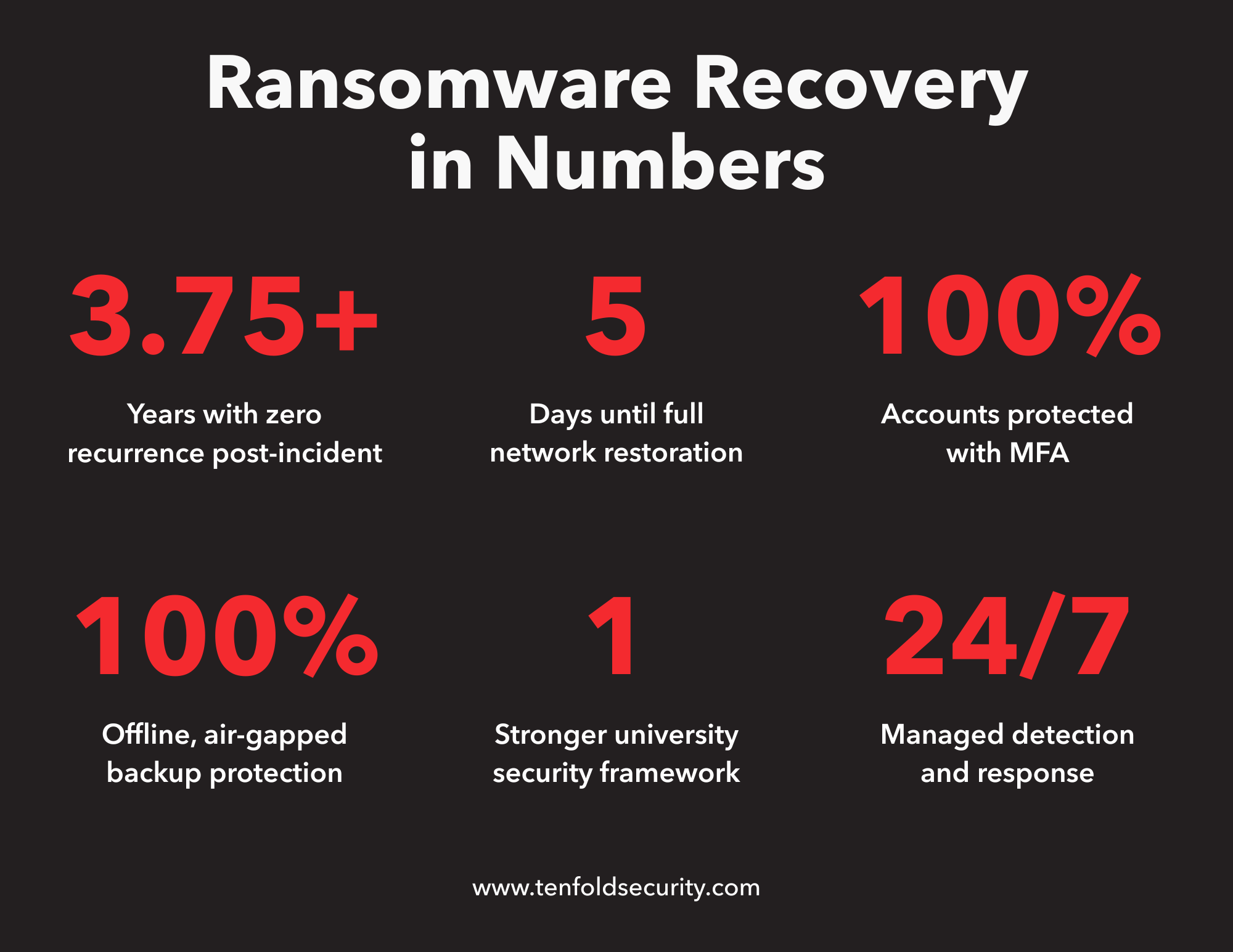
- 3.75+ years post-incident: zero ransomware recurrence and a fully hardened security posture.
- The university now operates with continuous managed detection and response, proactive vendor management, and tested incident response procedures.
Section 1
About the Organization
Our client is a mid-size public university located in the Midwest, serving thousands of students across multiple campuses. Like many higher education institutions, it operates a complex, sprawling IT environment: a mix of on-premises servers, cloud storage, third-party vendors for printing and offsite backups, and a large user base with varying levels of technical sophistication.
Universities are disproportionately targeted by ransomware actors. They hold sensitive student data protected under FERPA, operate with limited IT security budgets relative to their surface area, and face immense pressure to keep academic operations running continuously, making them attractive targets and likely to pay quickly.
Section 2
The Challenge: A Silent Breach That Became a Full Shutdown
The attack did not announce itself. It waited.
July: The Unseen Entry Point
The university's offsite cloud storage vendor (responsible for housing the organization's backup data) was hit by a ransomware attack. The vendor failed to notify the university for an entire month. During that window, threat actors quietly mapped the connection between the vendor and the university's internal network. A jump box used to bridge the two environments had been compromised, and Sentinel One (the endpoint detection tool running on that node) was silently disabled.
August: The Cascade Begins
On a Friday evening, university IT staff noticed databases behaving strangely and backups failing. They assumed a routine technical issue and began troubleshooting.
By Monday morning, the situation had escalated dramatically:
- Server slowdowns spread across the network
- Firewall logs filled to capacity
- File server CPUs maxed out
- Helpdesk tickets flooded in from across campus
On Tuesday, the first ransom email arrived, but it was buried in an overwhelmed inbox and went unread. IT staff were still treating this as a performance problem, not a security incident.
By Wednesday, the reality was unavoidable:
- All servers down and encrypted
- DHCP failed: the entire network was offline
- A second ransom demand was received
- Discovery that the university's offline backups (held by the third-party vendor) were gone
Root Causes That Made This Possible
No single failure caused this incident. It was the intersection of several common, preventable gaps:
- Incomplete MFA rollout: All but two accounts had multi-factor authentication enabled. The two exceptions (a printer service account and a secondary admin account) were the accounts exploited. The printer service account had been silently converted to interactive and given admin privileges.
- Open RDP port left unmanaged: a print vendor had required the university to open an RDP port to service printers. The work was completed, but the port was never closed. Over 300 external connections had been made through that open port before it was discovered.
- Vendor management nonexistent: the offsite backup vendor breach went unreported for a month. No security requirements, no verification of notifications, no contractual incident response obligations.
- Backups not truly offline: The vendor held what were supposed to be offline backups; but because the vendor was breached and shared a direct connection to the university, all backups were lost simultaneously.
- Limited incident response plan: there was no documented IR procedure, no communication plan, and no protocol for vendor-related incidents. Misinformation spread freely throughout the organization during the critical early hours.
Section 3
The Solution: Structured Response Under Pressure
Tenfold Security was engaged Wednesday: the day of full network failure. Within hours, our team had a structured plan of action in place.
Day 1: Triage and Containment
Our first priority was situational awareness. We created "swim lanes" (a parallel workstream model that allowed different response teams to work simultaneously on network analysis, device triage, forensics, and communication), rather than working sequentially through a crisis.
We immediately deployed Sentinel One and Velociraptor across all university devices. Sentinel One provided real-time endpoint detection and response; Velociraptor allowed us to perform rapid forensic collection and hunt for persistence mechanisms (techniques threat actors use to maintain long-term, uninterrupted access) across the environment, even with the network degraded.
Day 2—4: Identification and Remediation
With endpoints deployed, our team worked to identify every compromised device, isolate active threats, and begin clean restoration. Our key actions included:
- Identifying and closing the open RDP port and auditing all vendor access paths
- Disabling compromised accounts and resetting all credentials with enforced MFA
- Assessing which data was recoverable versus lost through the vendor breach
- Coordinating with cyber insurance to document the incident and manage communications
- Establishing a clear communication protocol internally to stop the spread of misinformation
Day 5: Full Restoration
By Saturday (five days after engagement) all devices were clean and the network was fully restored. The university's student registration process, a critical operational event, proceeded without disruption the following Monday.
Unlike generic incident response firms that deploy off-the-shelf playbooks, Tenfold Security's approach was methodical and environment-specific. We built the response around the university's actual infrastructure, vendor relationships, and operational priorities—not a generic template.
Section 4
The Results
restoration
post-incident
disruptions
Tenfold Security restored a fully encrypted, fully offline university network in five days. Fast enough to protect one of the most operationally critical events on the academic calendar: student registration.
But the more significant result is what has happened since. In the 3.75 years following the incident, the university has experienced zero ransomware recurrence and zero breaches. That outcome is not accidental, and is the direct result of the systematic remediation and security program improvements implemented following the response.
Post-incident, Tenfold Security worked with the university to address every root cause identified:
- MFA enforced across 100% of accounts, including service accounts
- Formal vendor management program established with security requirements and breach notifications SLAs
- Backup infrastructure redesigned: true offline, air-gapped backups with regular restoration testing
- Incident response plan documented, tabletop-tested, and updated annually
- Firewall change control process implemented with mandatory review cycles
- Ongoing managed detection and response (MDR) engagement with Tenfold Security
Section 5
What This Means For Your Organization
Ransomware doesn't discriminate by size or sector. If your organization has open vendor access paths, incomplete MFA coverage, or untested backup procedures, you share the same risk profile this university had before the attack.
The difference between a five-day recovery and a five-month nightmare comes down to preparation and the team you call on Day 1.
Tenfold Security provides:
- Incident Response (IR): rapid management, structured containment, and full restoration
- Managed Detection & Response (MDR): 24/7 monitoring to catch threats before they detonate
- Active Penetration Testing: test your team's readiness before an attacker tests it for you
Is Your Organization Prepared for a Ransomware Attack?
Contact us today to see how we can help your organization reduce risk and stay ahead of threats.

Frequently Asked Questions
FAQ: Ransomware Incident Response for Universities

.png)


Suite 50
Kansas City, MO 64105
